+8618335758886
 laura@xinhaimining.com



Gold Leaching Test: How to Evaluate Recovery, Reagent Consumption and Plant Feasibility?
 Sheena
 Oct 20, 2026
 4
If you want to know more details about equipment, solutions, etc, please click the button below for free consultation, or leave your requirements!
 Message
 Chat Now
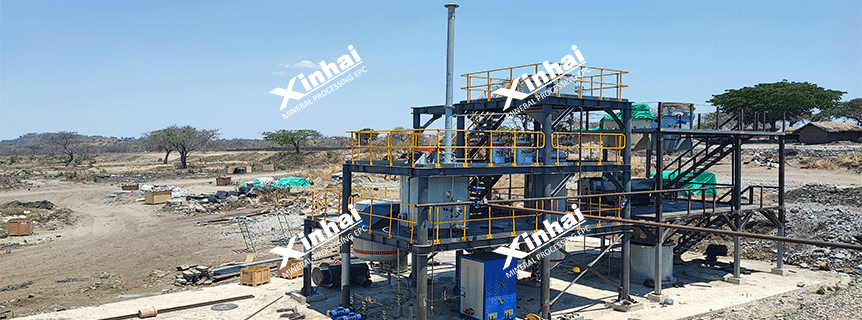
300-tpd-Gold-Leaching-and-Processing-Plant-Site-in-Tanzania
A gold leaching test is an essential step in evaluating whether gold ore can be processed economically before a mineral processing plant is designed or constructed. Although the gold grade indicates how much gold is present in the ore, it does not reveal how easily the gold can be dissolved, how much reagent is required, or how much gold can ultimately be recovered.
Through laboratory testing, mining companies can evaluate gold extraction, reagent consumption, leaching kinetics, and the influence of grinding conditions on processing performance. These results provide a technical basis for selecting a suitable gold leaching process, estimating equipment requirements, and assessing project economics. This guide explains the main gold leaching test methods, the key results to evaluate, and how test data can be translated into practical plant design and feasibility decisions.
01What is a Gold Leaching Test?
BackA gold leaching test is a metallurgical test used to determine how effectively gold can be dissolved from ore under specified chemical and operating conditions. It helps identify the conditions required to achieve a target extraction level and whether the ore is suitable for a proposed processing route.
The test program may involve different grinding sizes, reagent dosages, leaching durations, and solution conditions. The exact procedure depends on the ore mineralogy, the proposed processing method, and the questions that need to be answered.
Three important objectives guide a gold leaching test:
Evaluate gold extraction: Determine how much gold dissolves under the tested conditions and whether additional leaching time or pretreatment may be necessary.
Measure reagent consumption: Estimate the quantities of leaching reagents and pH-control chemicals consumed by the ore, rather than relying only on the initial dosage.
Support process selection: Establish whether the ore is better suited to agitated tank leaching, heap leaching, or a process incorporating additional recovery or pretreatment stages.
However, a laboratory result should not be treated as a guaranteed industrial recovery rate. Commercial performance also depends on ore variability, equipment operation, solution management, downstream gold recovery, and other factors that may not be fully represented in a small-scale test.
02What Should Be Evaluated Before Gold Leaching Testing?
BackBefore conducting a gold leaching test, the ore sample must be characterized. Two samples with similar gold grades can produce very different results because gold may occur as liberated particles, within sulfide minerals, or in association with carbonaceous material. Understanding these differences helps metallurgists select appropriate test conditions and avoid drawing incorrect conclusions from a single experiment.
2.1 Gold Mineralogy and Liberation
Mineralogical analysis helps determine how gold occurs in the ore and whether it is accessible to the leaching solution. Gold enclosed within quartz or sulfide minerals may not dissolve effectively unless the host minerals are sufficiently liberated or an appropriate pretreatment is applied.
Grinding may improve gold accessibility, but finer grinding also increases energy consumption and can complicate subsequent solid-liquid separation. Therefore, the objective is not necessarily to achieve the finest possible particle size, but to identify a suitable balance between gold extraction and processing cost.
2.2 Sulfide Minerals and Refractory Characteristics
Some gold ores contain pyrite, arsenopyrite, or other sulfide minerals that may host finely disseminated gold. These minerals can increase reagent consumption or limit gold extraction under conventional cyanidation conditions.
For such ores, diagnostic testing may be required to determine whether the gold is accessible through direct leaching or whether additional treatment, such as flotation concentration or an appropriate oxidation process, should be evaluated.
2.3 Carbonaceous Material and Preg-Robbing Potential
Certain carbonaceous ores contain naturally occurring materials that can adsorb dissolved gold from the leach solution. This phenomenon, known as preg-robbing, can reduce the amount of gold ultimately recovered even when gold dissolution initially occurs.
Testing should therefore distinguish between poor gold dissolution and gold losses caused by adsorption onto the ore. The distinction is important because these problems may require different process modifications.
2.4 Sample Representativeness
The test sample should represent the ore expected to feed the plant. If the deposit contains different mineralization zones, oxidation states, or sulfide contents, testing only one sample may produce misleading design assumptions.
For projects with significant ore variability, a broader sampling and test program can help establish how processing performance may change between ore types and mining stages.
03Common Gold Leaching Test Methods and Their Applications
BackDifferent gold leaching tests answer different technical questions. A preliminary laboratory test may be sufficient to screen several ore samples, while plant design may require more detailed work on extraction kinetics, reagent consumption, solution recovery, and process integration. The following methods are commonly considered when developing a gold processing test program.
3.1 Bottle-Roll Leach Test
A bottle-roll test is frequently used for preliminary evaluation of gold cyanidation. A representative ore sample is prepared at a specified particle size, mixed with the leaching solution, and agitated in a rotating bottle for a defined period.
The test can provide information about gold extraction over time, reagent consumption, and the potential influence of selected operating conditions. It is particularly useful for comparing samples or screening different test conditions before more extensive testing is undertaken.
However, a bottle-roll test does not automatically establish the final plant recovery. Its results may not fully represent industrial mixing, oxygen transfer, solid-liquid separation, carbon adsorption, or other process conditions.
3.2 Agitated Tank Leach Test
Agitated leach tests evaluate gold dissolution in a stirred slurry under controlled laboratory conditions. They can help assess the effects of pulp density, particle size, reagent dosage, mixing, and leaching duration.
These tests are especially relevant when considering conventional tank leaching and can support the preliminary evaluation of residence time and process conditions. Additional work may be needed to assess carbon adsorption, solution recovery, and the interaction between individual processing stages.
3.3 Column Leach Test
Column leach tests are commonly used to evaluate the behavior of ore intended for heap leaching. Prepared ore is placed in a column, and the leaching solution is applied under controlled conditions to investigate gold extraction and solution percolation.
The test can provide information about leaching performance, solution application, and potential hydraulic problems. It is particularly useful when ore permeability, particle size distribution, and agglomeration behavior may affect heap performance.
Column testing is generally more relevant to heap-leach evaluation than a conventional bottle-roll test alone. A short laboratory agitation test should not be used as the sole basis for predicting long-term heap-leach performance.
3.4 Diagnostic Leach Test
Diagnostic leaching is used when conventional testing does not adequately explain the distribution of gold losses. The procedure typically involves a sequence of selective treatments and leaching steps designed to investigate how gold is associated with different mineral phases.
It can help determine whether residual gold is associated with sulfides, carbonaceous material, or other difficult-to-process components. The findings can guide further mineralogical analysis and the selection of appropriate pretreatment options.
Diagnostic leaching is not required for every project. It is most valuable when the ore exhibits unexpectedly low extraction, significant residual gold, or characteristics suggesting refractory behavior.

04Which Results Matter Most in a Gold Leaching Test?
BackGold extraction is an important result, but it should not be evaluated in isolation. A test that produces high extraction under excessively fine grinding or high reagent consumption may not represent the most economical processing option. A useful test report should connect recovery performance with operating requirements and the likely behavior of the complete processing circuit.
4.1 Gold Extraction and Leaching Kinetics
Gold extraction measures the proportion of the gold in the tested feed that has been dissolved or recovered at a defined stage of the test. Leaching kinetics show how extraction changes over time.
For example, if extraction increases rapidly at first and then approaches a plateau, extending the leaching period may produce only a small additional benefit. If extraction remains low, the cause may involve insufficient liberation, unsuitable chemical conditions, refractory mineralogy, or other limitations. The interpretation should consider the full test profile rather than relying on one final measurement.
4.2 Reagent Consumption
Reagent consumption determines an important part of the operating cost. In cyanidation, sodium cyanide or another suitable cyanide source may be used for gold dissolution, while lime or another appropriate alkali may be required to control pH.
The amount added to a test is not necessarily the amount consumed. Some reagent may remain in solution at the end of the test, while some may react with minerals or be lost through other mechanisms.
A reliable assessment should therefore distinguish initial dosage, residual reagent concentration, and calculated consumption. This helps prevent reagent costs from being underestimated during feasibility studies.
4.3 Grind Size and Energy Requirements
Grinding affects the exposure of gold to the leaching solution. A finer grind may improve extraction when gold is locked within other minerals, but the benefit depends on the ore's mineralogy and liberation characteristics.
Testing several suitable grind sizes can help establish whether additional grinding produces enough incremental gold recovery to justify the associated energy consumption and equipment requirements.
The optimum grind size should therefore be determined by considering both metallurgical performance and the total processing cost.
4.4 Solution Recovery and Downstream Performance
Gold dissolution is not the same as final gold recovery. In a typical cyanidation circuit, dissolved gold must be recovered from the solution, for example through activated-carbon adsorption in a CIL or CIP circuit, or through another suitable recovery method.
If gold remains in solution or is lost during downstream processing, the final plant recovery will be lower than the measured leaching extraction. Tests should therefore consider the proposed recovery route whenever downstream performance may materially affect the project.
4.5 Residual Gold and Mass Balance
Residual gold in the leached solids helps identify whether significant gold remains undissolved. A reliable gold balance compares the gold entering the test with the gold measured in the relevant solid and liquid products.
Poor mass-balance closure may indicate sampling errors, analytical uncertainty, unaccounted solution losses, or other test problems. These issues should be investigated before the results are used for process design.
05How Do Gold Leaching Test Results Influence Process Design?
BackLaboratory results become valuable for engineering only when they are translated into practical design criteria. The test program should help answer not just whether gold can be leached, but how the required processing conditions can be achieved consistently at plant scale.
5.1 Selecting the Leaching Process
Test results, mineralogical data, and project constraints help determine whether conventional tank leaching, heap leaching, or a more complex flowsheet should be considered.
Tank leaching may be suitable when the ore requires controlled slurry processing and the project economics support the necessary grinding and agitation systems. Heap leaching may be attractive for suitable ores where solution percolation and relatively coarse ore processing are technically feasible.
Neither method is universally superior. The selection must consider gold extraction, processing time, ore characteristics, water availability, site conditions, and capital and operating costs.
5.2 Determining Grinding Requirements
Grinding tests and leaching results together help establish the particle size required for acceptable gold extraction. This information influences the selection and sizing of crushers, mills, classifiers, and associated equipment.
If finer grinding provides only a small improvement in extraction, the additional grinding cost may outweigh the metallurgical benefit. Conversely, if gold is poorly liberated at a coarser size, insufficient grinding may limit overall recovery.
The final design should be based on a suitable combination of mineral liberation, leaching performance, and energy requirements.
5.3 Estimating Leaching Residence Time and Tank Capacity
Leaching kinetics help engineers evaluate the time required to reach a target extraction under the tested conditions. For agitated tank circuits, the residence time is an important input when estimating the total effective slurry volume required for a given throughput.
A preliminary estimate can be expressed as: Effective slurry volume = Slurry volumetric flow rate × Required residence time
The actual installed tank capacity must also account for factors such as usable working volume, operating flexibility, mixing requirements, and the number of tanks in the circuit. Laboratory residence time should not be transferred directly into plant design without considering scale-up and operating conditions.
5.4 Evaluating Gold Recovery Equipment
The selected leaching and downstream recovery processes determine which equipment must be included in the flowsheet. Depending on the process, this may include leaching tanks, agitators, activated-carbon adsorption systems, screens, pumps, solution treatment equipment, and solid-liquid separation facilities.
Equipment sizing requires more than a recovery percentage. Engineers also need reliable information about throughput, slurry properties, residence time, solution flow, solids handling, and the operating conditions of the complete circuit.
06How Do Gold Leaching Test Results Affect Plant Economics?
BackGold leaching tests provide inputs for preliminary capital expenditure (CAPEX) and operating expenditure (OPEX) estimates. However, test data alone cannot establish project feasibility. They must be combined with mine planning, plant design, infrastructure requirements, gold-price assumptions, and other project-specific information.
6.1 Capital Expenditure
CAPEX is affected by the selected flowsheet and the equipment required to achieve the design throughput and recovery objectives. A finer grinding requirement, longer leaching residence time, additional pretreatment, or more complex gold recovery circuit may increase the initial investment.
For heap-leach projects, pad construction, solution collection, pumping, and associated infrastructure are important considerations. For tank-leach projects, grinding, tanks, agitation, carbon adsorption, and tailings management may represent significant cost components.
Test results help define the process requirements, but a complete CAPEX estimate must also include civil works, utilities, infrastructure, engineering, construction, commissioning, and contingency allowances appropriate to the project stage.
6.2 Operating Expenditure
OPEX depends on the resources required to process each tonne of ore. Important cost drivers include:
Reagents: Cyanide or other leaching reagents, pH-control chemicals, and any additional reagents required by the flowsheet.
Energy: Electricity for crushing, grinding, pumping, agitation, and other process equipment.
Water: Process-water supply, recycling, and water-treatment requirements.
Maintenance and consumables: Equipment wear, replacement parts, carbon handling where applicable, and routine maintenance.
Test results can help estimate some of these costs, particularly reagent consumption and grinding requirements. Actual operating costs still depend on equipment efficiency, site conditions, supply prices, operating practices, and the degree of water and reagent recycling.
6.3 Gold Recovery and Revenue Potential
Higher gold extraction can increase the quantity of gold available for recovery and sale, but additional extraction is not always economically justified if it requires disproportionate spending.
For example, extending residence time or increasing grinding intensity may improve extraction while also increasing energy consumption, equipment requirements, or throughput constraints. The correct decision depends on the incremental value of the additional recovered gold relative to the incremental cost.
Economic evaluation should therefore compare alternative flowsheets and operating conditions using consistent assumptions for ore throughput, head grade, recovery, gold price, and operating costs.
6.4 Sensitivity Analysis and Project Risk
A feasibility assessment should examine how project economics change when key assumptions vary. Important variables may include head grade, gold extraction, reagent consumption, throughput, energy costs, and the availability of suitable ore.
Sensitivity analysis helps identify the variables with the greatest effect on project value and the uncertainties that require further investigation. Where ore variability is significant, additional testing may be necessary before a final process design or investment decision is made.
07Conclusion
BackA reliable gold leaching test connects ore mineralogy, gold extraction, reagent consumption, process design, and economic evaluation, providing the technical foundation for selecting and developing a suitable gold processing plant.


RELATED PRODUCTS
-
Ceramic Vacuum Filter
-
Hydraulic Motor Driving Center Thickener
-
Rod Mill