+8618335758886
 laura@xinhaimining.com



Complete Practical Guide to Flotation Process
 zeki
zeki
 Aug 31, 2026
 416
416
If you want to know more details about equipment, solutions, etc, please click the button below for free consultation, or leave your requirements!
 Message
 Chat Now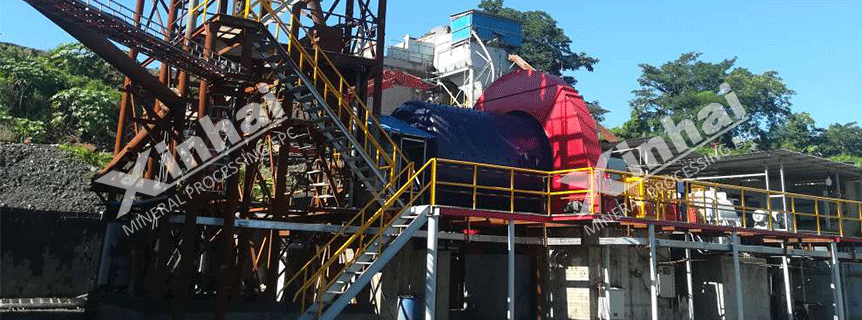
Fiji-2000-tpd-Gold-Mine-Flotation
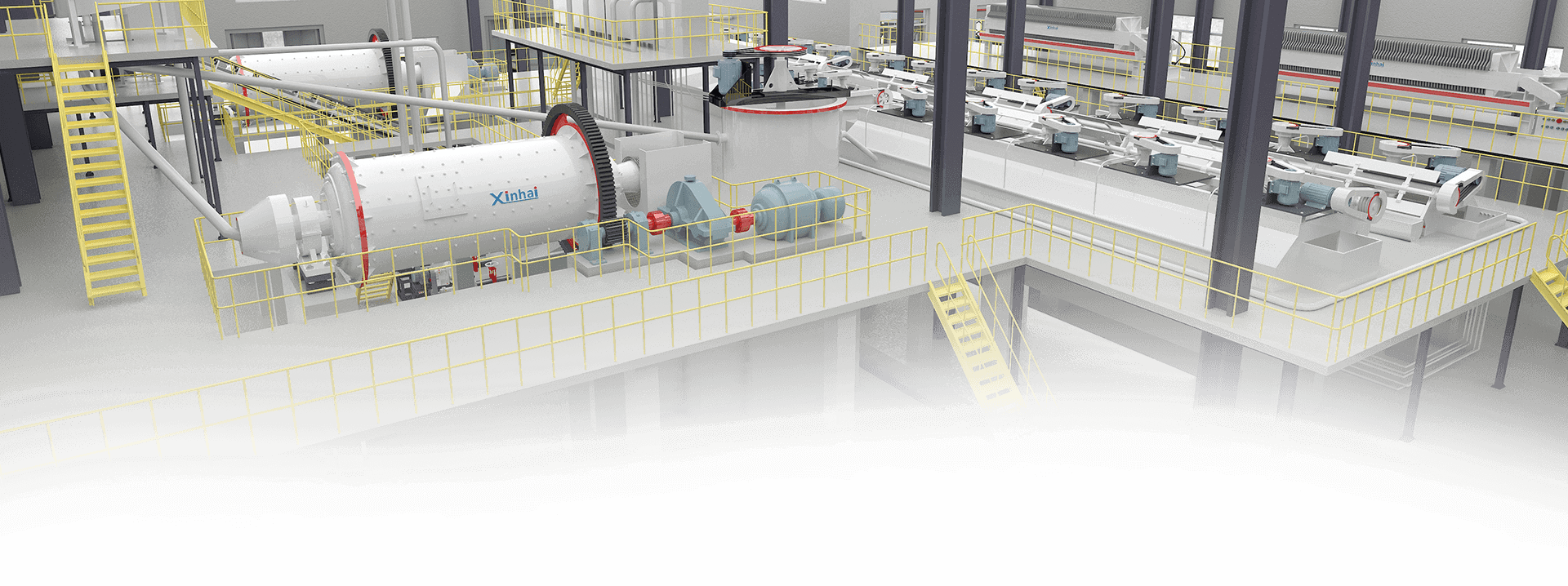
Flotation is the most widely-used mineral separation method in mineral processing plants. It separates different minerals within pulp systems based on the wettability differences of mineral surfaces. Featuring strong adaptability, flotation can process fine-grained and micro-fine complex intergrown ores and produce high-grade concentrates. Nevertheless, this process relies on flotation reagents and imposes strict requirements on grinding liberation degree and pulp condition control. It holds an irreplaceable position in the beneficiation of non-ferrous metals, precious metals and certain non-metallic minerals.
01Working Principle of Flotation
BackFlotation operations are carried out in the pulp tank of flotation equipment. After crushing, grinding and classification, valuable minerals and gangue minerals achieve monomer liberation and are prepared into pulp of proper concentration. Various flotation reagents are added during the pulp conditioning stage to directionally modify the hydrophilic or hydrophobic properties of different mineral surfaces.
The flotation machine keeps stirring and injects air, generating numerous dispersed fine bubbles inside the pulp. Target mineral particles with strong hydrophobicity collide with bubbles, firmly attach to bubble surfaces to form mineralized bubbles, and rise to the pulp surface to build a stable froth layer. Froth is scraped off to obtain flotation concentrates. Hydrophilic gangue minerals can hardly adhere to bubbles, remain in the pulp and are finally discharged as tailings along with pulp flow.
Simplified flotation process flow: Grinding & Classification → Reagent Addition and Pulp Conditioning → Roughing → Cleaning → Scavenging → Final Products Output
02Ore Types Suitable for Flotation Treatment
Back1.Non-ferrous metal sulfide ores
Flotation serves as the core beneficiation method for sulfide ores of copper, lead, zinc, nickel, molybdenum and other metals. Most of these ores are polymetallic intergrown deposits with minor density differences among minerals, so gravity separation and magnetic separation cannot realize effective separation.
2.Precious-metal associated ores
Gold and silver rarely occur as large independent particles; most are associated inside sulfide minerals such as pyrite and chalcopyrite. Flotation enriches gold-bearing sulfides into sulfide concentrates, from which gold and silver can be further recovered via smelting or cyanidation processes.
3.Oxidized metal ores
Flotation is combined with magnetic separation and gravity separation for some oxidized minerals of iron, manganese, titanium, tungsten and tin. Oxidized ore flotation demands higher selectivity of collectors.
4.Non-metallic mineral beneficiation
Flotation is mainly applied for purification and impurity removal in non-metallic mineral processing. It is extensively adopted for purifying fluorite, apatite, spodumene, feldspar, talc and graphite.
03Major Flotation Equipment
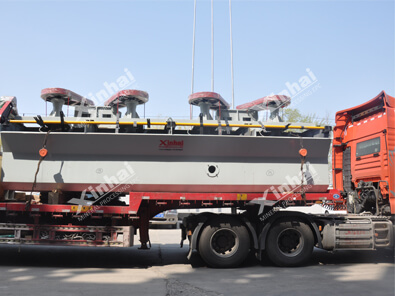
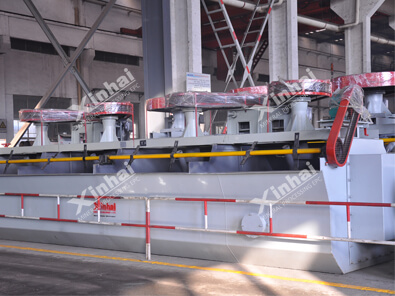
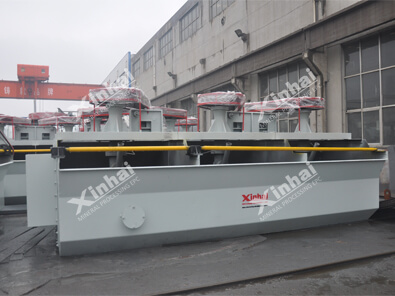
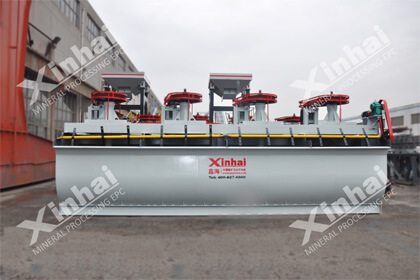
BackFlotation equipment can be classified in multiple ways. In industrial practice, classification is mainly based on agitation-aeration modes and equipment structures; classification by feed particle size and pulp flow pattern is also adopted.
1.Mechanical Agitation Flotation Machine
The most widely-applied model in mineral processing plants. High-speed rotation of internal impellers agitates pulp while negative pressure draws in air to produce bubbles.
(1)Advantages: Wide adaptability, convenient on-site operation, flexible adjustment of aeration volume and froth scraping speed.
(2)Disadvantages: Severe impeller wear; separation performance deteriorates for ores with high slime content.
2.Pneumatic Flotation Column
No impeller agitation mechanism. External blowers supply air into the column. Pulp flows downward while bubbles rise upward for counter-current contact separation.
(1)Advantages: Superior cleaning performance, high froth grade, small footprint and low energy consumption.
(2)Disadvantages: Sensitive to feed fluctuations; not suitable for coarse-grained ores or high-slime ores.
04Conclusion
BackThis is the complete guide to flotation technology. Thanks to its excellent mineral adaptability, flotation acts as a core separation technique for complex ores. However, flotation performance is highly dependent on grinding liberation degree, reagent regime, pulp pH value and equipment operating conditions. Even for the same ore type, mineral properties vary greatly among different mines, so existing processes cannot be copied directly.


RELATED PRODUCTS
-
BF Flotation Cell
-
JJF Flotation Cell
-
SF Flotation Cell