+8618234403483
 yanzhang19990421@gmail.com



How to Recover Gold from Tailings Efficiently?
 Sheena
 Jul 21, 2026
 407
407
If you want to know more details about equipment, solutions, etc, please click the button below for free consultation, or leave your requirements!
 Message
 Chat Now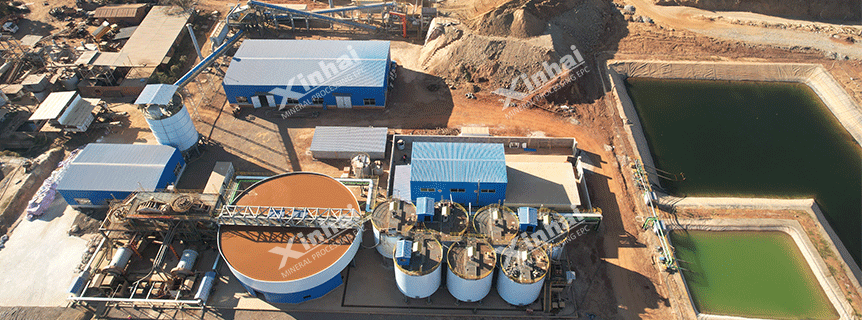
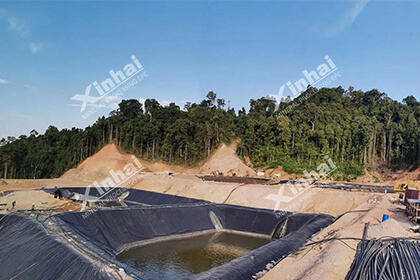
gold-tailings-reprocessing-plant
Recovering gold from tailings is not simply a matter of applying cyanide or installing new equipment. The success of a tailings reprocessing project depends on understanding the characteristics of the tailings, selecting the appropriate recovery technology, and designing an optimized process flow that balances recovery rate, operating costs, and environmental compliance.
This article explains why gold remains in tailings, how to evaluate tailings before reprocessing, the most effective recovery methods, the typical process flow, and practical strategies for maximizing gold recovery efficiency.
01Why Do Gold Tailings Still Contain Recoverable Gold?
BackGold tailings are the materials left after the initial extraction process. Although they were once considered waste, many tailings storage facilities still contain economically recoverable gold. In some historic operations, overall gold recovery was only 70–85%, leaving a considerable amount of gold behind. Several factors contribute to residual gold in tailings.
1.1 Outdated Processing Technologies
Many mines built decades ago relied on gravity concentration, amalgamation, or early cyanidation systems. These methods were less effective at recovering fine or complex gold particles than modern processing technologies.
1.2 Fine and Ultra-Fine Gold Particles
Very fine gold particles are difficult to recover using conventional gravity methods. Without sufficient grinding or advanced separation equipment, much of this gold remains in the tailings.
1.3 Gold Locked Inside Sulfide Minerals
Gold is often encapsulated within pyrite, arsenopyrite, or other sulfide minerals. Unless these minerals are sufficiently liberated or oxidized, conventional leaching cannot dissolve the gold effectively.
1.4 Economic Limitations During Original Mining
When gold prices were significantly lower, operators often optimized production costs rather than maximizing recovery. Tailings that were uneconomic decades ago may now represent profitable resources. Understanding how gold occurs within the tailings is the foundation for selecting the most effective recovery process.
02Evaluate Your Gold Tailings Before Choosing a Recovery Method
BackEvery tailings deposit is unique. A successful reprocessing project begins with comprehensive laboratory testing rather than equipment selection.
2.1 Determine the Gold Grade
The first step is to analyze the gold content throughout the tailings storage facility. Modern drilling and sampling programs help identify both average grades and high-grade zones. Even relatively low-grade tailings can become economically viable when large volumes are available and recovery costs remain low.
2.2 Identify Gold Mineralogy
Understanding how gold occurs within the tailings is one of the most important steps in designing an efficient recovery process. Gold can exist in several different forms, and each requires a different extraction strategy. If the mineralogical characteristics are not fully understood, even the most advanced processing plant may fail to achieve the expected recovery.
Mineralogical studies are typically conducted using techniques such as Mineral Liberation Analysis (MLA) and QEMSCAN, which automatically identify minerals, measure particle size, and determine the association between gold and gangue minerals. These analyses help engineers evaluate the degree of gold liberation and select the most suitable beneficiation process.
The most common forms of gold occurrence in tailings include:
Free gold – Gold particles are fully liberated from surrounding minerals and can usually be recovered efficiently through gravity separation or cyanidation.
Gold associated with sulfides – Gold is closely attached to sulfide minerals such as pyrite or arsenopyrite. Flotation is often used to concentrate these sulfides before further treatment.
Gold locked within quartz or gangue minerals – Gold particles remain encapsulated inside quartz or other host minerals. Additional grinding is often required to liberate the gold before recovery.
Refractory gold – Gold is extremely fine or chemically trapped within sulfide minerals, making it difficult for cyanide to dissolve directly. Pretreatment methods such as flotation, bio-oxidation, roasting, or pressure oxidation may be required to improve recovery.
A comprehensive mineralogical study provides the technical foundation for selecting the most effective recovery route while minimizing unnecessary processing costs.
2.3 Conduct Metallurgical Tests
Once the mineralogy has been identified, metallurgical testing is carried out to evaluate how the tailings respond to different recovery methods. These laboratory tests simulate actual plant conditions and provide critical data for process selection, equipment sizing, and economic evaluation.
Rather than relying on theoretical recovery rates, metallurgical testing allows engineers to determine the most efficient and cost-effective processing route for a specific tailings deposit.
Common metallurgical tests include:
Gravity Recoverable Gold (GRG) Test – Measures the proportion of gold that can be recovered through gravity separation alone. A high GRG value indicates that installing a gravity circuit can significantly improve overall recovery while reducing downstream processing costs.
Flotation Test – Evaluates the flotation performance of sulfide minerals carrying gold and determines the optimum reagent scheme, grinding size, and concentrate grade.
Bottle Roll Cyanidation Test – Simulates the cyanide leaching process in laboratory conditions to determine the maximum achievable gold recovery, cyanide consumption, and optimum leaching time.
Leaching Kinetics Test – Examines how quickly gold dissolves during cyanidation, helping engineers optimize tank retention time and improve plant productivity.
Cyanide Consumption Test – Measures the amount of cyanide required to achieve target recovery. High cyanide consumption may indicate the presence of copper minerals, reactive sulfides, or other cyanide-consuming materials that affect operating costs.
The combination of these tests provides reliable technical data for designing an efficient process flow and estimating both capital and operating costs before commercial production begins.
03Four Proven Methods to Recover Gold from Tailings Efficiently
BackThere is no universal solution for gold tailings reprocessing because every tailings deposit differs in gold grade, particle size, mineral composition, and historical processing methods. In practice, the highest recovery is often achieved by combining two or more technologies into an integrated process flow rather than relying on a single recovery method. The following methods are the most widely used in modern gold tailings reprocessing plants.
3.1 Gravity Separation
Gravity separation is usually the first recovery stage in a gold tailings reprocessing plant because it offers a simple, low-cost method of recovering coarse liberated gold without using chemical reagents. The process separates gold from lighter gangue minerals based on differences in specific gravity. Since gold is much denser than most waste minerals, it can be concentrated using centrifugal force or flowing water. Gravity recovery not only produces an early gold concentrate but also reduces the amount of gold entering downstream flotation or cyanidation circuits, lowering reagent consumption and improving overall plant efficiency.
Gravity separation is most suitable for:
Tailings containing coarse free gold particles
Gold that has already been liberated during previous grinding
Tailings with relatively low clay content, which allows efficient particle separation
In many modern plants, gravity separation can recover 30–60% of the total gold before the material enters flotation or leaching circuits, making it one of the most cost-effective recovery stages.
3.2 Flotation
When gold occurs together with sulfide minerals such as pyrite, arsenopyrite, or chalcopyrite, flotation becomes one of the most effective recovery methods. Instead of recovering the gold directly, flotation concentrates the gold-bearing sulfide minerals into a much smaller volume, allowing subsequent leaching to process a higher-grade concentrate.
During flotation, collectors are added to selectively attach to sulfide mineral surfaces. Air bubbles carry these particles to the surface, where they are removed as concentrate, while unwanted gangue minerals remain in the slurry. Flotation is particularly valuable for tailings generated from older gravity plants, where significant amounts of sulfide-associated gold were previously discarded.
Depending on the mineralogy and flotation conditions, flotation typically achieves 70–90% recovery of sulfide-associated gold, making it an essential process in many tailings reprocessing projects.
3.3 Cyanidation (CIL/CIP)
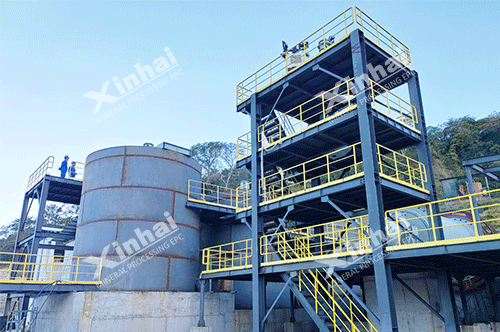
Cyanidation remains the most widely used method for recovering fine liberated gold from tailings because of its high recovery efficiency and proven industrial performance. In Carbon-in-Leach (CIL) and Carbon-in-Pulp (CIP) systems, cyanide solution dissolves gold into a soluble complex, which is then adsorbed onto activated carbon. The gold is subsequently recovered through elution, electrowinning, and smelting to produce doré bars.
Compared with gravity separation, cyanidation is particularly effective for recovering fine particles that cannot be separated physically. With proper process control, modern CIL/CIP plants commonly achieve 85–95% gold recovery, making cyanidation the core process in most gold tailings reprocessing plants.
3.4 Heap Leaching
Heap leaching is an economical option for processing large volumes of low-grade gold tailings, particularly where constructing a conventional processing plant is not economically justified. Instead of pumping slurry through tanks, tailings are stacked on an impermeable leach pad and irrigated with cyanide solution. As the solution percolates through the heap, it dissolves gold, which is collected at the bottom for further recovery.
Although heap leaching generally produces lower recovery than CIL, its simplicity and low capital investment make it attractive for certain projects. Heap leaching is most appropriate when tailings have low clay content, adequate permeability, and grades that support long-term, low-cost recovery rather than rapid production.
Particle size directly affects the recovery process.
Coarse liberated gold is suitable for gravity recovery.
Fine particles generally require flotation or cyanidation.
Extremely fine particles may require ultrafine grinding before leaching.
A size-by-size gold assay helps determine where most of the gold is concentrated.
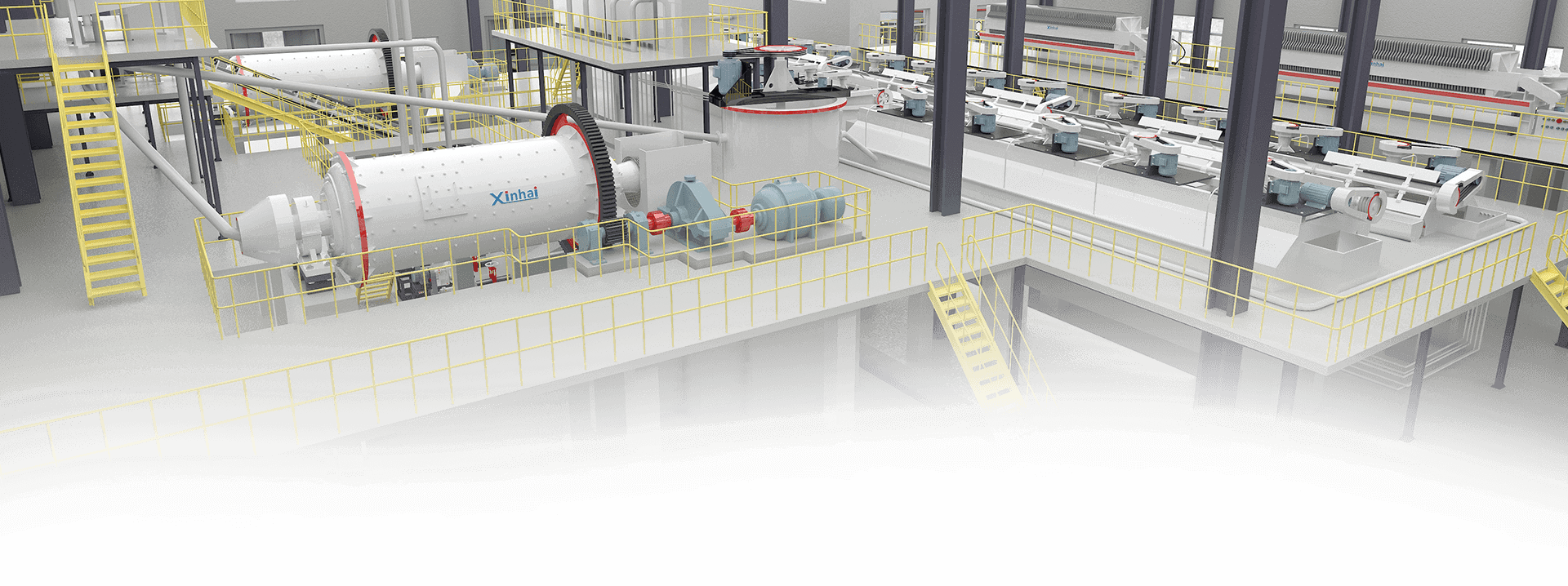
04Typical Gold Tailings Reprocessing Flow Sheet
BackWhile every project requires a customized design, a typical gold tailings reprocessing plant follows these steps:
Tailings Excavation or Hydraulic Mining – Recover tailings from storage facilities and transport them to the processing plant.
Screening and Desliming – Remove debris, oversized materials, and excessive clay to improve downstream efficiency.
Grinding (If Required) – Regrind coarse particles to liberate encapsulated gold.
Gravity Recovery – Recover coarse free gold using centrifugal concentrators or shaking tables.
Flotation (Optional) – Concentrate sulfide-associated gold before leaching.
CIL/CIP Leaching – Dissolve fine gold using cyanide and recover it with activated carbon.
Gold Recovery – Elution, electrowinning, and smelting produce doré bars.
Tailings Detoxification and Disposal – Treat residual cyanide and safely dispose of processed tailings through lined storage facilities or dry stacking systems.
This integrated flow sheet maximizes recovery while reducing operating costs and environmental risks.
05Choosing the Right Gold Tailings Recovery Solution
BackThere is no universal solution for gold tailings reprocessing. Every deposit differs in gold grade, mineral composition, particle size distribution, and historical processing methods. The most successful projects begin with detailed sampling, laboratory testing, and pilot-scale verification before selecting equipment and designing the process flow.
Working with an experienced mineral processing partner can help optimize recovery, reduce operating costs, and minimize project risks. From metallurgical testing and process design to equipment manufacturing, plant construction, and commissioning, an integrated EPC or EPCM approach ensures that each stage of the project is engineered to maximize both technical performance and long-term profitability.
06Conclusion
BackGold tailings are no longer viewed simply as mining waste—they represent a valuable secondary resource with significant economic and environmental potential. By thoroughly evaluating tailings characteristics, selecting the appropriate combination of gravity separation, flotation, cyanidation, or other advanced recovery methods, and optimizing the entire processing flow, mining companies can unlock substantial value from historical tailings while supporting more sustainable resource utilization.


RELATED PRODUCTS
-
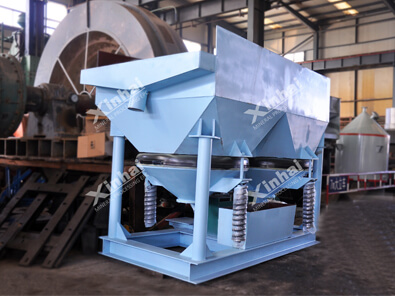
Jig
-
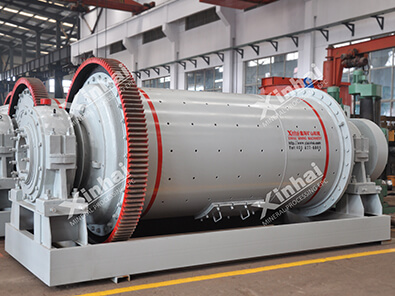
Energy Saving Ball Mill
-
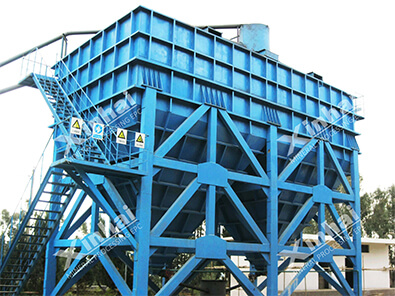
Tilted Plate Thickener