+8618234403483
 yanzhang19990421@gmail.com



Full Analysis of Lead-Zinc Ore Beneficiation Process
 zeki
zeki
 Jul 28, 2026
 8
8
If you want to know more details about equipment, solutions, etc, please click the button below for free consultation, or leave your requirements!
 Message
 Chat Now
.gif "Mexican-1,500-tpd-polymetallic-mine-(copper,-lead,-zinc,-gold,-and-silver).gif")
Mexican-1,500-tpd-polymetallic-mine-(copper,-lead,-zinc,-gold,-and-silver)
Lead-zinc ore is a globally vital strategic non-ferrous metal mineral resource. Efficient separation and comprehensive utilization of lead and zinc minerals directly support the development of metallurgy, new energy, equipment manufacturing and national defense industries. This paper systematically reviews the mineralogical characteristics of lead-zinc ores, mainstream mineral processing flowsheets and supporting core equipment, providing practical technical references for mineral processing scheme design in mines.
01Overview of Lead-Zinc Ore
BackLead-zinc ore is a polymetallic paragenetic orebody dominated by galena and sphalerite, mostly formed in hydrothermal sedimentary sequences and skarn deposits.
1.Major Valuable Minerals
Lead-bearing minerals: galena, cerussite, anglesite
Zinc-bearing minerals: sphalerite, smithsonite, hemimorphite
2.Common Gangue Minerals and Harmful Associated Components
Quartz, calcite, dolomite, chlorite, sericite, pyrite, pyrrhotite, barite and clay minerals occur widely as associated minerals. Harmful impurities such as arsenic, cadmium, antimony and carbonaceous shale are often closely intergrown with target minerals.
02Industrial Value and Application Fields of Lead-Zinc Ore
BackLead and zinc rank fourth and fifth respectively among the most consumed base non-ferrous metals worldwide, and are known as fundamental raw materials for modern manufacturing. After smelting, lead and zinc concentrates can endow materials with unique mechanical properties, anti-corrosion performance and electrochemical characteristics, with applications covering most industrial sectors.
1.Metallurgy and Alloy Industry
Zinc features excellent rust resistance and is extensively applied in hot-dip galvanizing for steel plates, steel structures and automotive components. When added into copper-tin-aluminum alloys, lead improves machinability, wear resistance and radiation shielding performance, and is widely used in bearing alloys and protective components.
2.New Energy Battery Sector
Lead-acid batteries remain the mainstream energy storage equipment for vehicles, energy storage power stations and communication standby power supplies. High-purity zinc serves as a critical raw material for anode coatings of lithium batteries and zinc-air batteries.
03Three Mainstream Mineral Processing Technologies for Lead-Zinc Ore
BackIn light of differences in density, magnetism, electrical conductivity, surface chemical properties and occurrence state between lead-zinc minerals and gangue minerals, three principal separation technologies have been developed for industrial application. Combined processes are commonly adopted in production to boost metal recovery rates.
1.Gravity Separation
Gravity separation realizes separation relying on the density difference between heavy lead-zinc minerals and light gangue such as quartz and calcite. This technology requires no chemical reagents, featuring low operating costs and environmental friendliness.
(1) Applicable scenarios
Preconcentration of coarse-grained veined lead-zinc ore, weathered oxidized ore, and recovery of coarse-grained lead and zinc from tailings.
Core equipment includes spiral chutes, jigs and shaking tables.
(2) Process characteristics
It is mostly adopted as a preconcentration operation prior to flotation to discard large quantities of waste rock in advance and reduce the processing capacity of subsequent flotation circuits.
2.Flotation
Flotation represents the most widely adopted core technology for lead-zinc separation. By adjusting the hydrophobicity difference of mineral surfaces via reagents, target minerals attach to air bubbles and get separated from gangue. Three mainstream industrial flotation flowsheets are listed as follows:
(1) Selective flotation (lead flotation followed by zinc flotation)
Lime is used to raise pulp alkalinity; zinc sulfate is added to depress sphalerite. Lead-selective collectors are used to float galena preferentially. Copper sulfate is then added into lead tailings to activate sphalerite for subsequent zinc flotation.
(2) Bulk flotation
Lead-zinc bulk concentrate is floated first, followed by regrinding to realize lead-zinc separation. This process is mainly applied to ores with extremely tight intergrowth of lead and zinc and low run-of-mine ore grade.
(3) Equiflotability flotation
Minerals are separated by grades according to their floatability, which cuts down the consumption of excessive depressants and activators. It is suitable for lead-zinc ores with complex intergrowth and polymetallic paragenesis.
Core equipment consists of SF and BF series flotation machines, matched with multi-stage roughing, cleaning and scavenging operations.
3.Magnetic Separation
Magnetic separation achieves separation based on differences in mineral magnetic susceptibility, mainly removing associated magnetic impurity minerals in lead-zinc ore.
(1) Low-intensity magnetic separation
Removes magnetite and pyrrhotite from gravity separation coarse sand to prevent magnetic impurities from entering lead-zinc concentrates and adversely affecting smelting.
(2) High-intensity magnetic separation
Separates iron-bearing sphalerite from non-magnetic gangue. The higher the iron content in sphalerite, the stronger its magnetism. Magnetic separation helps upgrade zinc concentrate purity.
04Introduction to Core Supporting Equipment for Lead-Zinc Mineral Processing
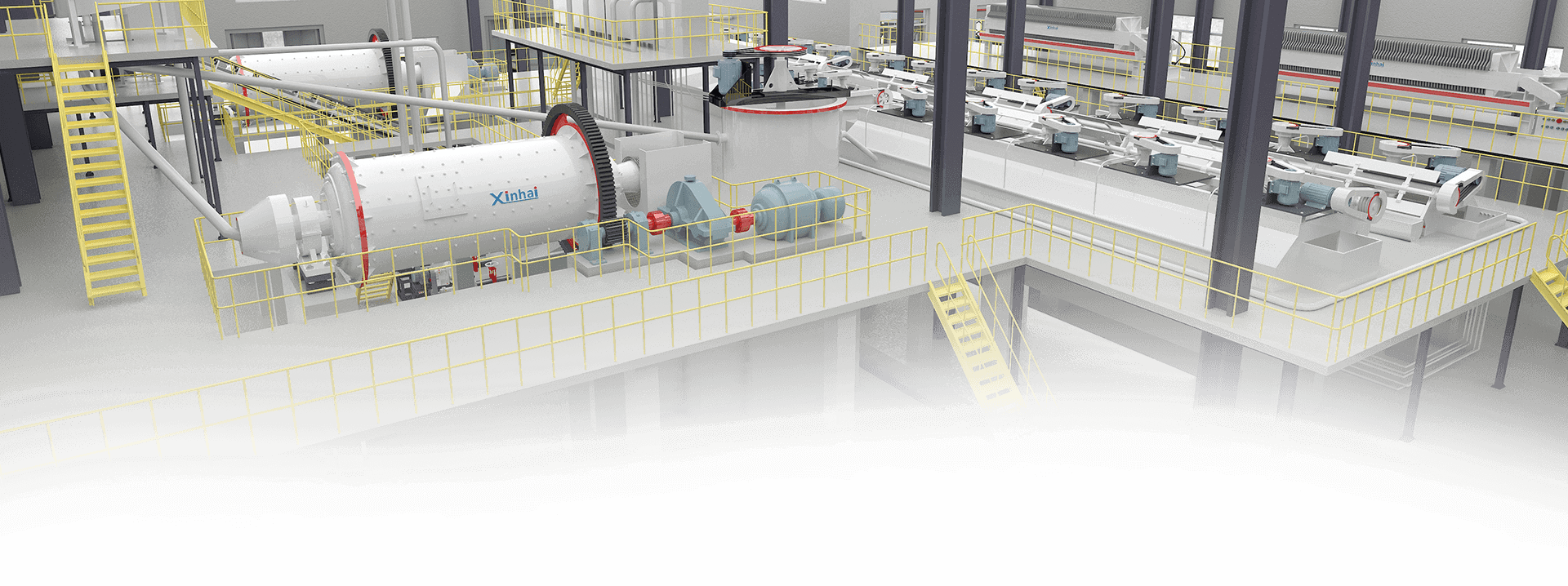
BackA complete lead-zinc mineral processing production line consists of crushing, grinding, separation and dewatering equipment. These units coordinate with each other to form a continuous production flow. The equipment models and combination schemes vary significantly according to ore properties.
1.Crushing Equipment
Crushing serves as the pretreatment process at the front end of mineral processing, breaking large run-of-mine ore into particles with suitable feed size for grinding.
(1) Commonly used equipment
Jaw crusher / cone crusher
(2) Jaw crushers are used for primary crushing to handle massive raw ore; cone crushers undertake secondary and tertiary crushing to produce crushed ore with uniform particle size and stabilize the grinding load in downstream processes.
2.Grinding Equipment
The objective of grinding is to liberate intergrown lead-zinc minerals for subsequent separation.
(1) Commonly used equipment
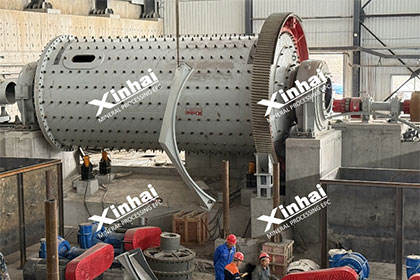
Ball mill
(2) Ball mills are the mainstream grinding equipment in lead-zinc mines. They are often combined with spiral classifiers and hydrocyclones to form closed-circuit grinding circuits.
3.Gravity Separation Equipment
(1) Commonly used equipment
Shaking table / jig / spiral chute
(2) Shaking tables are mostly used for cleaning of fine-grained lead-zinc ore; jigs are suitable for preconcentration and waste discarding of coarse and medium-grained ores; spiral chutes occupy small floor space and need no auxiliary power, and are often deployed in tailings circuits to recover lost coarse-grained lead and zinc minerals.
4.Flotation Equipment
(1) Commonly used equipment
SF-type and BF-type self-aerated flotation machines
(2) These machines are applicable to roughing and scavenging operations. Small flotation columns are mostly deployed in cleaning sections to effectively improve the grades of lead concentrate and zinc concentrate.
5.Magnetic Separation Equipment
(1) Commonly used equipment
Wet low-intensity magnetic separator, high-gradient high-intensity magnetic separator
(2) Low-intensity magnetic separators remove pyrrhotite and magnetite; high-gradient magnetic separators can eliminate argillaceous impurities, separate iron-bearing sphalerite and reduce the content of harmful impurities in concentrates.
6.Preconcentration and Auxiliary Separation Equipment
(1) Commonly used equipment
Gamma-ray ore sorter
(2) Mainly used for preconcentration of open-pit run-of-mine ore to remove waste rock before the crushing stage.
7.Dewatering Equipment
(1) Commonly used equipment
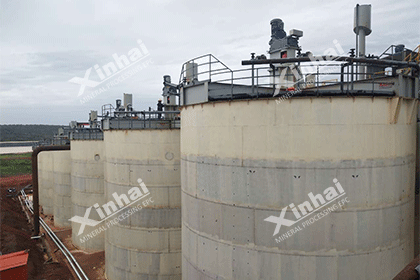
Thickener / filter press
(2) Thickeners realize preliminary sedimentation of pulp; filter presses achieve deep dewatering of concentrates to produce lead and zinc concentrates meeting moisture content standards. Meanwhile, clean water can be recycled to mineral processing circuits to realize cyclic utilization of water resources.
05Conclusions
BackThis paper systematically elaborates on the fundamental characteristics, industrial application value, mainstream mineral processing technologies and complete set of core processing equipment for lead-zinc ore. With the continuous depletion of high-grade sulfide lead-zinc resources, oxidized mixed ores and reprocessing of low-grade tailings will become the primary development trends of the industry. Intelligent mineral processing equipment, green and low-carbon combined mineral processing flowsheets and highly selective eco-friendly flotation reagents represent key research directions in this sector.