+8618234403483
 yanzhang19990421@gmail.com



A Beginner's Guide to Tungsten Ore Processing
 zeki
zeki
 Feb 27, 2026
 913
913
If you want to know more details about equipment, solutions, etc, please click the button below for free consultation, or leave your requirements!
 Message
 Chat Now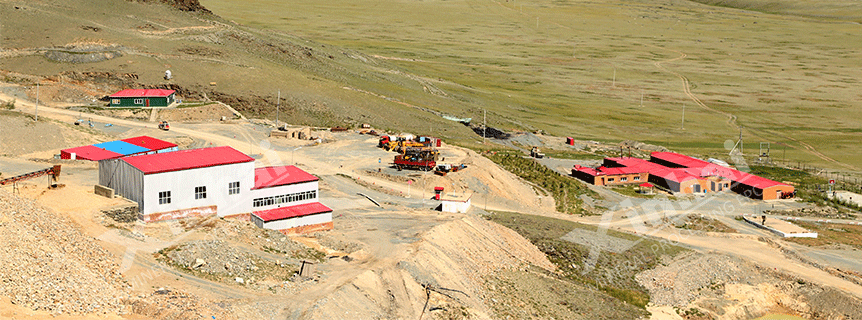
Mongolia-150TPD-Tungsten-Gravity-Separation-Plant
As a strategically significant rare metal, the processing technology for tungsten is a critical link in the efficient utilization of its resources. Aimed at entry-level readers, this guide starts with the core logic of gravity separation for wolframite and flotation for scheelite. It systematically breaks down the complete process specifications, from crushing and grinding to gravity separation, flotation, and magnetic separation, while clarifying equipment parameters and safety/environmental requirements. The objective is to help beginners quickly establish a professional foundational knowledge, master the fundamentals of standardized operation, and lay a solid groundwork for subsequent in-depth study and practical application.
01Tungsten Ore Processing Techniques
BackTungsten ore processing techniques primarily utilize gravity separation and flotation, which can be further detailed based on the ore type:
1. Wolframite (Primarily Gravity Separation)
(1) Characteristics
High density, low hardness, prone to sliming.
(2) Core Process Flow
Crushing → Classified Gravity Separation → Rougher Concentrate / Magnetic Separation / Cleaning
2. Scheelite (Primarily Flotation)
(1) Characteristics
Good floatability, often closely associated with calcium-bearing gangue minerals (e.g., calcite).
(2) Core Process Flow
Grinding → Flotation → Rougher Concentrate Cleaning (often with heating) → Final Concentrate.
02Equipment Required for Tungsten Ore Processing
Back1. Crushing and Screening Stage
(1) Jaw Crusher
(2) Cone Crusher
(3) Vibrating Screen
2. Grinding and Classification Stage
(1) Ball Mill
(2) Spiral Classifier
(3) Hydrocyclone
3. Gravity Separation Stage
Mainly applicable to wolframite
(1) Jig
(2) Shaking Table
(3) Spiral Chute
(4) Centrifugal Concentrator
4. Flotation Stage
Mainly applicable to scheelite
(1) Flotation Machine
(2) Conditioning Tank
(3) Pump
5. Dewatering Stage
(1) Thickener
(2) Filter
(3) Hydrocyclone
03Key Considerations in Tungsten Ore Processing
Back1. Process-Ore Matching
(1) Ore Type Differentiation
Wolframite primarily uses gravity separation; scheelite primarily uses flotation. Mixing these processes is strictly prohibited.
(2) Particle Size Control
Grinding fineness must be determined based on the ore's liberation characteristics to avoid over-grinding or insufficient liberation.
2. Core Operational Standards
(1) Grinding and Classification
Maintain stable pulp density and circulating load. Prevent over-grinding for wolframite; ensure sufficient liberation for scheelite.
(2) Gravity Separation Operations
Strictly control feed rate, wash water volume, and stroke frequency/amplitude. Perform timely cleaning to prevent material misplacement or contamination between circuits.
(3) Flotation Operations
Precisely control pH value. Reagents must be added strictly according to the prescribed dosage and schedule. Ensure proper desliming pretreatment is carried out.
04Conclusion
BackThis guide focuses on the core logic of the complete processing flowsheet, clearly defining the primary pathways of gravity separation for wolframite and flotation for scheelite. It details the key control points in grinding, flotation, and equipment operation, while strictly adhering to safety and environmental protection fundamentals. For beginners, consolidating foundational knowledge and standardizing operations are essential. By continuously optimizing processes based on data, one can build a solid foundation for efficient tungsten processing, facilitating further technical advancement and improved production performance indicators.


RELATED PRODUCTS
-
Rock Drilling Equipment
-
Leaching Agitation Tank
-
Drum Filter