+8618234403483
 yanzhang19990421@gmail.com



Beginner's Guide to Grinding Equipment
 zeki
zeki
 Jan 29, 2026
 702
702
If you want to know more details about equipment, solutions, etc, please click the button below for free consultation, or leave your requirements!
 Message
 Chat Now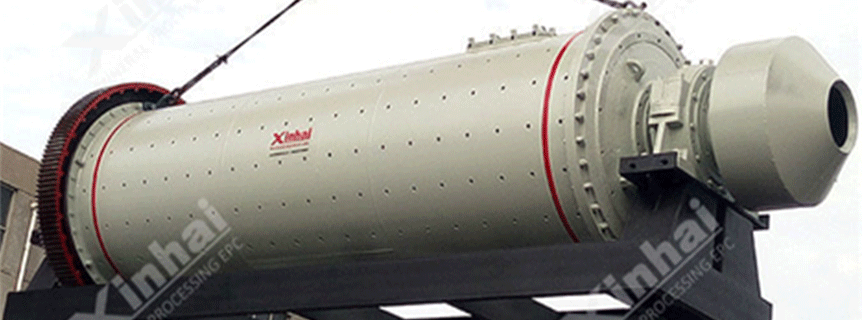
Wet-Rod-Mill
Grinding equipment is a core and critical piece of equipment in the mineral processing process, which directly determines the mineral liberation effect and subsequent separation efficiency, and is also an important starting point for mines to reduce costs, improve efficiency and achieve green and intelligent development. This guide provides introductory analysis from basic cognition, industrial positioning to selection principles, offering a fundamental reference for the understanding and practical application of grinding equipment.
01Basic Cognition and Industrial Positioning of Grinding Equipment
Back1. Basic Cognition
(1)Grinding equipment is a core device for fine and ultra-fine grinding of materials in mining, building materials, chemical engineering and other fields. It processes crushed coarse materials into fine-grained materials meeting technological requirements through impact, grinding, extrusion and other forces, and is one of the links with the highest energy consumption ratio and the strongest technological correlation in the mineral processing process.
(2)The mainstream core models are divided into two categories, adapted to different grinding requirements:
Ball mill/Rod mill
Vertical mill/Roller press/Raymond mill
2. Industrial Positioning
(1) Industrial Chain Core
It is a key link in the middle reaches of mineral processing, which determines the comprehensive utilization efficiency of mineral resources and is a prerequisite for subsequent separation processes.
(2) Indispensable Mining Equipment
It is essential for the processing of all types of minerals, and its demand is highly correlated with the scale of mineral mining and processing.
02Working Principles and Classification of Grinding Equipment
Back1. Working Principles
It mainly relies on the transmission device to drive slow rotation. Materials are fed from the feeding end of the cylinder, and crushed by the falling impact and autogenous grinding of grinding media (steel balls, steel rods and the ore itself) inside the cylinder. Continuous feeding creates pressure that propels the materials inside the cylinder to move from the feeding end to the discharging end. Materials reaching the finished product particle size are discharged from the discharging end of the cylinder.
2. Equipment Classification
Classified by grinding media: Ball mill, Rod mill, Autogenous mill.
Classified by process operation: Dry grinding, Wet grinding.
Classified by discharge mode: Grid-type mill, Overflow-type mill.
3. Equipment Types
Wet Energy-Saving Grid Ball Mill- MQGg
Wet Grid Ball Mill- MQG
Cylinder Energy-Saving Overflow Ball Mill- MQYg
Wet Overflow Ball Mill - MQY
Dry rod mill - MBS
Dry ball mill - Φ900×1800
Wet rod mill - MBY
High-Efficiency Autogenous Mill- ZMJ
Raymond mill - MTM
03Core Principles and Considerations for Grinding Equipment Selection
Back1. Core Selection Principles
(1) Process Adaptation
Match the raw material characteristics, grinding particle size/capacity requirements, and meet the technical standards of subsequent separation processes.
(2) Economic Efficiency
Take into account the initial investment and the whole life cycle cost, and prioritize models with low energy consumption and convenient operation and maintenance.
(3) Stability and Reliability
Adapt to on-site working conditions, ensure the continuous operation of equipment, and reduce downtime losses.
(4) Green Compliance
Comply with environmental protection and energy-saving policies, and meet the requirements of green production in mines.
(5) Adaptability and Expansion
Take into account the plant layout and the connection of supporting equipment, and reserve space for subsequent capacity upgrading.
2. Core Considerations
(1) Material Characteristics
Ore hardness, dissemination size, ore grindability, moisture content.
(2) Process Requirements
Grinding product particle size, processing capacity, operation mode.
(3) Cost Dimension
Equipment procurement cost, installed power/energy consumption, wear part consumption, labor/maintenance cost.
04Conclusion
BackGrinding equipment is the core equipment of mineral processing. Its selection and application must adhere to the principles of process adaptation and economic efficiency, and take into account multi-dimensional factors such as materials, on-site conditions and costs. Grasping the basic characteristics and industrial trends of equipment, and conducting scientific selection and rational configuration can meet the production needs, and lay a solid technological foundation for mines to reduce costs, improve efficiency and achieve green and intelligent development.


RELATED PRODUCTS
-
Activated Carbon Regenerator
-
Carbon Screen
-
Press Filter
.jpg "Grinding Machine in the Factory")