+8618234403483
 yanzhang19990421@gmail.com



How to Choose the Right Shaking Table in Mineral Processing?
 Sheena
 Apr 11, 2026
 761
761
If you want to know more details about equipment, solutions, etc, please click the button below for free consultation, or leave your requirements!
 Message
 Chat Now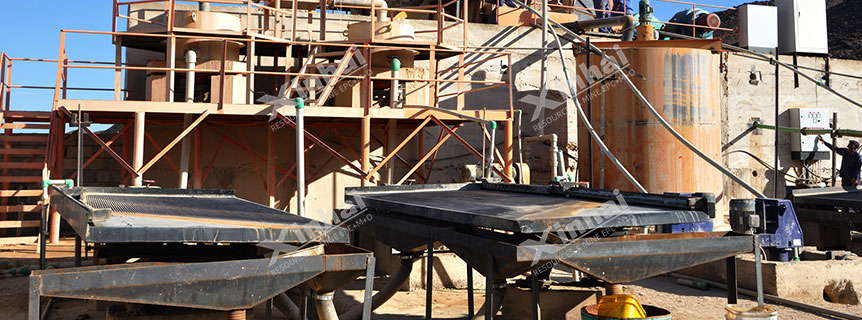
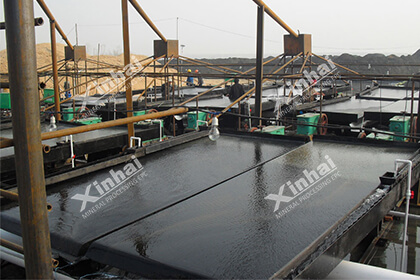
A-shaking-table-used-in-iron-ore-processing-plant
01What Is a Shaking Table in Mineral Processing?
BackA shaking table is a gravity separation device used to separate minerals based on differences in density. It is widely applied in the processing of gold, tungsten, tin, and other heavy minerals. Unlike flotation or magnetic separation, a shaking table does not rely on chemical or magnetic properties. Instead, it uses a combination of water flow, deck motion, and particle density differences to achieve separation.
02How Does a Shaking Table Work?
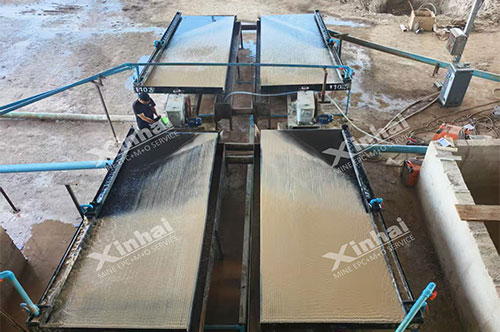
BackUnderstanding the working principle is essential before choosing the right equipment. A shaking table consists of a slightly inclined deck that moves back and forth in an asymmetric motion. At the same time, water flows across the surface.
During operation:
Heavier particles settle quickly and remain close to the deck surface
Lighter particles are lifted by water and move further away
The combined effect of vibration and water flow creates distinct separation zone. As a result, materials are separated into different bands according to density and particle size. The efficiency of this process depends heavily on how well the operating conditions match the material characteristics.
03Key Factors to Consider When Choosing a Shaking Table
BackSelecting the right shaking table is not about choosing the"best"model, but the most suitable one for your ore.
3.1 Ore Type and Mineral Density
The first factor is the density difference between valuable minerals and gangue. Shaking tables perform best when there is a clear density contrast.
For example:
Gold, tungsten, and cassiterite (high density) are ideal
Fine or low-density minerals are more difficult to separate
If density differences are small, other methods such as flotation may be more effective.
3.2 Particle Size Range
Particle size has a direct impact on separation performance. Typical effective range: 0.02 mm to 2 mm
If particles are too coarse: They may not move properly across the table
If particles are too fine: They can be carried away by water and lost
Proper classification before feeding the shaking table is essential.
3.3 Feed Capacity Requirements
Different shaking table models are designed for different throughputs. Key considerations: Small laboratory or pilot scale; Medium processing plants; Large industrial operations. Choosing a table that is too small leads to bottlenecks, while oversizing increases capital cost without improving efficiency.
3.4 Deck Design and Surface Type
The deck is the most critical part of a shaking table. Common types include: Coarse sand deck; Fine sand deck; Slime deck. Each is designed for a specific particle size range.
For example: Coarse decks handle larger particles; Slime decks are designed for very fine materials
Matching deck type with particle size is crucial for achieving stable separation.
3.5 Stroke Length and Frequency
The motion of the table affects how particles stratify and move. Longer stroke usually better for coarse particles, while higher frequency is better for fine particles. Incorrect settings can disturb the separation zones and reduce recovery.
3.6 Water Flow Rate
Water flow controls how particles are transported across the deck. If too much water will valuable minerals may be washed away; if too little water the poor separation and material may buildup. A stable and adjustable water supply system is therefore essential.
3.7 Installation and Operational Conditions
Other practical factors include: Available space; Water supply conditions; Ease of operation and maintenance. In many cases, the best performance comes not from the most advanced equipment, but from a well-matched system and proper operation. A shaking table should always be selected based on test results or mineral analysis, not assumptions.
04Conclusion
BackChoosing the right shaking table requires a clear understanding of both the equipment and the material being processed. There is no universal model that works for all conditions. Instead, the best results come from: Matching the table design to particle size; Adjusting operating parameters carefully; Considering the overall process flow.
In mineral processing, effective separation is not achieved by a single machine, but by selecting the right combination of equipment and conditions.


RELATED PRODUCTS
-
High Dam Spiral Classifier
-
Activated Carbon Regenerator
-
Underground Loading Equipment