+8618234403483
 yanzhang19990421@gmail.com



Introduction to Three Underground Mining Methods
 zeki
zeki
 Mar 31, 2026
 516
516
If you want to know more details about equipment, solutions, etc, please click the button below for free consultation, or leave your requirements!
 Message
 Chat Now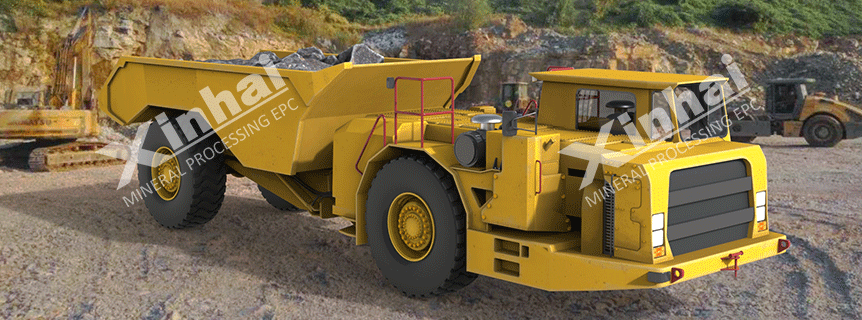
Underground-Dump-Truck
Underground mining is an important approach to mineral resource development, mainly applied to deep-buried ore bodies where open-pit mining is uneconomical. Based on the stability of ore and rock and ground pressure control mechanisms, it can be categorized into three types: open stoping, filling mining, and caving mining. A reasonable selection of mining methods is critical to ensuring mining safety, improving resource recovery, controlling dilution and ore loss, and protecting the surface environment. It also serves as a core technical link for efficient and stable mine production.
01Main Underground Mining Methods
BackUnderground mining refers to a series of mining technologies that extract ore from ore bodies through tunneling and stoping works beneath the surface. Its classification is mainly determined by ore-rock stability, orebody occurrence conditions, and ground pressure management modes.
1. The primary methods are as follows:
(1) Open Stoping Mining Method
(2) Filling Mining Method
(3) Caving Mining Method
02Open Stoping Mining Method
Back1. Core Principle
Mined-out areas are supported by ore pillars and the stability of surrounding rocks; stopes are mined first, followed by ore pillars.
2. Classifications
(1) Breast Stoping
Suitable for flat/ gently inclined, thin to medium-thick (≤5–7 m) orebodies with stable ore and rock; full-seam advance with irregular ore pillars.
(2) Room-and-Pillar Stoping
Applied to flat/ gently inclined, medium-thick orebodies; alternating arrangement of rooms and regular pillars; commonly used for low-grade orebodies where surface subsidence is permitted.
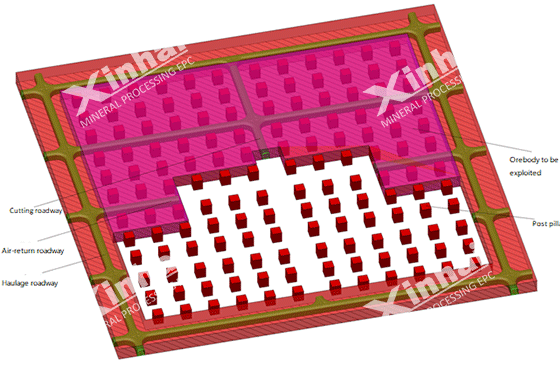
Room-and-Pillar
(3) Shrinkage Stoping
Used for steeply inclined, thin to medium-thick orebodies with stable ore and rock; blasted ore is temporarily stored in the stope and drawn centrally at the final stage.
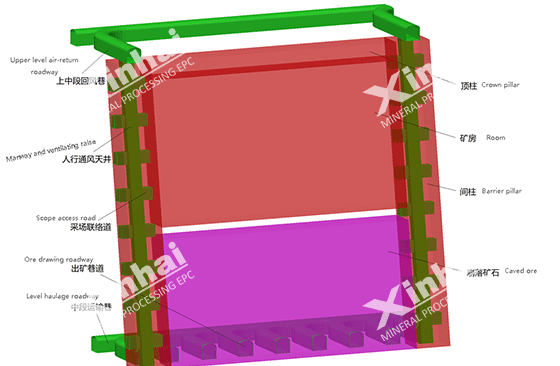
Shrinkage Stoping
(4) Sublevel Stoping
Designed for thick and large stable orebodies; sublevel stoping with large stopes and high efficiency.
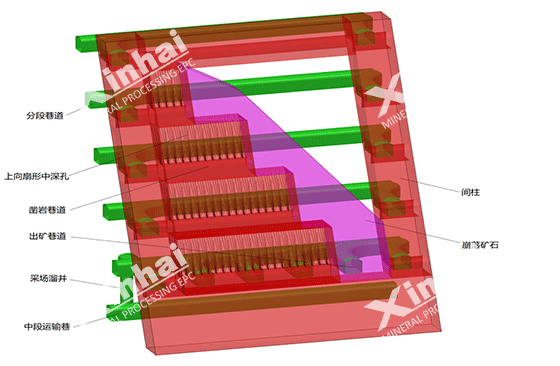
Sublevel Stoping
3. Applicable Conditions
(1) Stable ore and rock
(2) Surface subsidence allowed
(3) Ore of ordinary value.
03Filling Mining Method
Back1. Core Principle
Backfilling is conducted synchronously with mining; filling bodies support surrounding rocks, control ground pressure, and protect the surface.
2. Classifications
(1) Upward Cut-and-Fill Stoping
Stoping and filling are carried out in layers from bottom to top.
(2) Downward Drift Cut-and-Fill Stoping
Suitable for highly unstable surrounding rocks and high-value orebodies; drift stoping from top to bottom with cemented filling as the roof.
(3) Sloping Wall Stoping
Used for extremely thin veins; separate mining of ore and wall rock, with waste rock filling to reduce dilution.
3. Applicable Conditions
(1) High-value ores
(2) Unstable surrounding rocks
(3) Surface requiring protection
(4) Deep mining.
04Caving Mining Method
Back1. Core Principle
Surrounding rocks are caved synchronously with mining; caved waste rock fills mined-out areas to manage ground pressure in a single-step stoping process.
2. Classifications
(1) Sublevel Caving Without Pillars
Suitable for thick and large orebodies with medium to unstable conditions; no bottom structure, sublevel caving with end drawing; high efficiency and wide application.
(2) Sublevel Caving With Pillars
Applied to thick and large unstable orebodies; equipped with bottom structures for centralized ore drawing; suitable for medium and large mines.
(3) Block Caving
Designed for thick and large orebodies with well-developed joints and easy cavability; caving induced by self-weight or engineering measures; low cost.
3. Applicable Conditions
(1) Unstable surrounding rocks
(2) Thick and large orebodies
(3) Surface subsidence allowed
(4) Ore of ordinary value
05Conclusion
BackUnderground mining is the primary method for extracting deep-buried ore bodies, divided into open stoping, filling, and caving methods according to ground pressure control mechanisms. An appropriate method is selected based on orebody occurrence, ore-rock stability, and surface protection requirements. On the premise of ensuring surrounding rock stability and production safety, efficient ore recovery is realized with controlled dilution and ore loss, meeting the mining demands of various mines.