+8618234403483
 yanzhang19990421@gmail.com



Properties of Zimbabwe Gold Ores and Their Impacts on Mineral Processing Technology
 zeki
zeki
 May 22, 2026
 475
475
If you want to know more details about equipment, solutions, etc, please click the button below for free consultation, or leave your requirements!
 Message
 Chat Now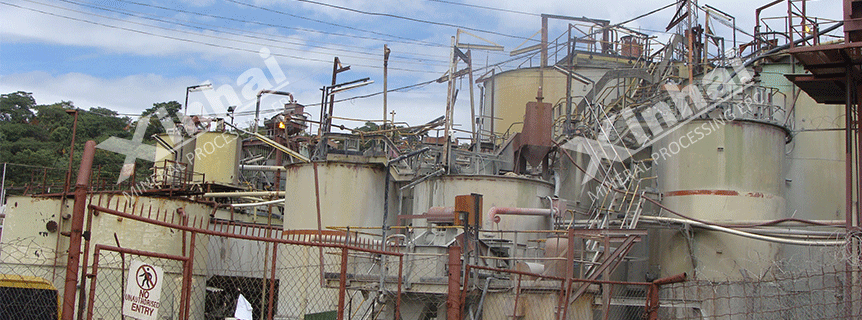
Zimbabwe-1500kg-Desorption-Electrolysis-System
Zimbabwe is a major gold-producing country in Africa. Its gold deposits are dominated by quartz vein-type and altered rock-type primary ores, accompanied by placer gold deposits. The gold minerals feature complex occurrence states, wide particle size distribution, and distinct variations in mud and sulfide contents, which directly determine the beneficiation schemes and recovery indicators. Based on actual ore properties of mining areas, this paper systematically analyzes mineral composition, texture and structure, gold occurrence regularity, as well as the adaptability to gravity separation, flotation, cyanide leaching and other processes, providing references for process optimization and efficiency improvement of concentrators.
01Material Composition of Gold Ores
Back1.Main Chemical Components
The gold grade of typical raw ores in Zimbabwe ranges from 3–5 g/t, and high-grade zones reach 8–12 g/t. The associated silver content is 7%–20%, possessing comprehensive recovery value. Silicon dioxide serves as the primary gangue component, followed by alumina, magnesium oxide and calcium oxide. Pyrite is the predominant metallic mineral, with minor amounts of pyrrhotite, sphalerite, chalcopyrite and arsenopyrite. Partial ores contain carbonaceous and clay minerals, exerting remarkable adverse effects on leaching and flotation.
2.Mineral Constituents
Target mineral: Native gold (silver-gold alloy), the main recovery object.
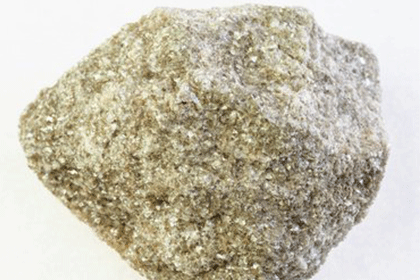
Metallic minerals: Pyrite accounts for over 95% of sulfide minerals, presenting as idiomorphic to hypidiomorphic granular aggregates in massive and layered forms. Small quantities of arsenopyrite, chalcopyrite and galena are also detected.
Gangue minerals: Quartz, sericite, chlorite, feldspar and calcite. Laterite-type ores contain abundant clay with severe argillization, which easily coats gold particles.
02Ore Texture and Structure
BackDiverse textures and structures significantly influence mineral dissociation and separation efficiency.
1.Granular structure
Native gold and pyrite form idiomorphic and hypidiomorphic crystals with uneven grain sizes. Disseminated and veinlet structures are prevalent, where gold and sulfides distribute along quartz fractures and vein interstices.
2.Inclusion structure
Large quantities of native gold exist as fine inclusions inside pyrite and arsenopyrite, or are encapsulated by quartz and clay, resulting in difficult monomer dissociation.
3.Replacement and fractured structure
Sulfides and quartz mutually replace each other, and gold accumulates along replacement boundaries and fractures. Tectonic movement fractures gold grains and sulfide edges, facilitating grinding dissociation while bringing risks of over-grinding.
4.Earthy and scaly structure
Clay and sericite in altered and laterite ores aggregate in scaly and earthy forms. High mud content tends to block processing equipment and reduce separation efficiency.
03Core Mineral Characteristics
Back1.Native Gold
(1)Occurrence forms: Fracture gold, intergranular gold and inclusion gold. Micro-fine to fine grains predominate with particle sizes of 5–30 μm, and coarse visible gold up to 200 μm can be found locally.
(2)Particle size distribution: Coarse gold (>0.1 mm) takes up 15%–25%, medium-fine gold (0.01–0.1 mm) accounts for 50%–60%, and micro-fine gold (<0.01 mm) occupies 15%–25%, showing obvious mixed grain size features.
(3)Dissemination relationship: Gold is mostly symbiotic with pyrite, among which 60%–70% is enclosed in sulfides, and the rest distributes in quartz intergranular spaces and fractures. Placer gold mostly exists in granular and flaky shapes with high dissociation degree, suitable for gravity separation recovery.
2.Pyrite
As the dominant gold-bearing mineral with content of 5%–25%, pyrite has mixed coarse and fine grains and compact texture. Gold is embedded as fine inclusions or fracture gold. Insufficient grinding fails to expose gold grains, leading to low direct cyanide leaching recovery. Flotation enrichment or pretreatment is required prior to leaching.
3.Gangue Minerals
Quartz features high hardness and poor grindability, becoming the major source of grinding energy consumption. Clay and sericite are prone to argillization, which adsorbs flotation reagents and covers gold particles, lowering flotation recovery and leaching rate. Pre-washing and desliming are necessary pretreatment procedures.
04Occurrence and Dissemination Characteristics of Gold
Back1.Dissemination Particle Size
(1)Coarse gold (>0.1 mm): Recovered preferentially by jig, shaking table and centrifugal concentrator to avoid metal loss.
(2)Medium-fine gold (0.01–0.1 mm): Low gravity separation recovery, requiring combined flotation and cyanide leaching.
(3)Micro-fine and submicroscopic gold (<0.01 mm): Mostly enclosed in sulfides, efficient recovery relies on fine grinding and leaching treatment.
2.Occurrence Forms
(1)Free gold: Abundant in placer and oxidized ores with high dissociation degree, achieving favorable gravity separation performance.
(2)Sulfide-included gold: The dominant occurrence form and main cause of refractory primary ores. Flotation is adopted to enrich gold-bearing sulfides in advance.
(3)Fracture and intergranular gold: Commonly seen in oxidized and weakly altered ores, easy to dissociate after grinding and applicable to flotation and leaching.
(4)Gangue-included gold: Wrapped by quartz and clay. Grinding fineness shall be strictly controlled to prevent inadequate dissociation or over-grinding.
(5)Overall Dissociation Degree: The dissociation rate reaches 70%–80% for oxidized ores, while only 40%–60% for primary sulfide ores. Reasonable grinding and classification improve dissociation effect effectively.
05Key Mineralogical Factors Affecting Gold Recovery
Back1.Gold particle size and occurrence state
High proportion of coarse gold increases gravity separation proportion; massive micro-fine inclusion gold demands combined flotation and cyanidation. Combined gravity separation-flotation-cyanidation process realizes comprehensive recovery rate over 90% for mixed grain ores.
2.Type and content of sulfide minerals
Pyrite and arsenopyrite are major gold carriers. Higher sulfur content reduces direct leaching efficiency, hence sulfide enrichment via flotation is essential. Copper and lead sulfides consume cyanide reagents and interfere leaching reaction, needing impurity removal beforehand.
3.Argillization and mud content
High mud content in laterite and strongly altered ores raises reagent consumption and destabilizes separation indexes. Desliming serves as a critical pretreatment step.
4.Carbonaceous materials and harmful impurities
Carbonaceous substances adsorb dissolved gold and cause gold loss, sharply decreasing leaching efficiency. Roasting and oxidation pretreatment are applied to eliminate inhibitory effects.
06Process Adaptability Analysis and Recommended Schemes
Back1.Gravity Separation
Application scope: Placer gold ores, oxidized ores and primary ores containing coarse visible gold. Prior recovery of coarse gold reduces subsequent processing load.
Advantages: Low operation cost, eco-friendliness and simple flow, suitable for areas with unstable power supply.
Common equipment: Jig, water jacket centrifugal concentrator, 6S shaking table, pulsating sluice box.
2.Flotation
Application scope: High-sulfide primary ores, enriching gold-bearing sulfides into concentrates for subsequent gold cyanidation.
Advantages: Efficient enrichment of micro-fine gold-bearing minerals with high concentrate grade.
Key control parameters: Desliming treatment, pH adjustment, xanthate collectors and gangue depression.
3.Cyanide Leaching
Application scope: Micro-fine gold, sulfide concentrates and low-grade oxidized ores (heap leaching & agitated leaching). pH value is controlled at 11–11.5, matched with zinc cementation or activated carbon adsorption.
All-slime cyanidation (CIP/CIL): Suitable for micro-fine disseminated ores, recovery rate ranges from 88%–94%.
4.Recommended Combined Processes
(1)Placer gold and high-oxidation ores with visible gold: Washing → gravity separation (centrifugal concentrator + shaking table) → tailings auxiliary leaching, recovery rate 85%–95%.
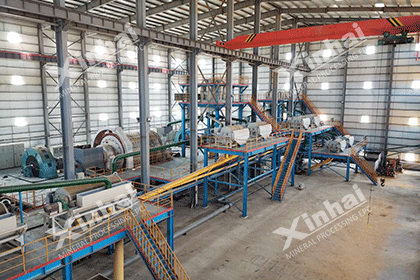
(2)Mainstream primary sulfide ores: Crushing → grinding and classification → priority coarse gold gravity separation → gold-bearing sulfide flotation → concentrate regrinding → cyanide leaching, stable comprehensive recovery around 90%.
(3)Low-grade oxidized ores: Heap leaching + activated carbon adsorption, low investment for large-scale treatment, recovery rate 70%–80%.
07Conclusion
BackZimbabwean gold ores are mainly quartz vein-type and altered rock-type deposits with medium gold grade and relatively simple mineral composition. Wide gold particle size range, dominant sulfide encapsulation, partial argillization and carbonization are core restrictive factors for beneficiation. Gravity separation must be arranged in the front flow to recover coarse gold and avoid loss from over-grinding. Flotation combined with cyanidation acts as the core technology for efficient recovery of sulfide-encapsulated gold. Washing, desliming and targeted pretreatment are required for muddy and carbonaceous ores to stabilize technical indicators and cut reagent consumption. Practical production verifies that the combined gravity separation-flotation-cyanidation process perfectly adapts to Zimbabwean gold ore properties, achieving high gold recovery with controllable costs, which is the optimal selection for new-built and renovated local concentrators.