+8618234403483
 yanzhang19990421@gmail.com



Chrome Mining Methods: Open-Pit vs Underground Mining
 Sheena
 Apr 14, 2026
 718
718
If you want to know more details about equipment, solutions, etc, please click the button below for free consultation, or leave your requirements!
 Message
 Chat Now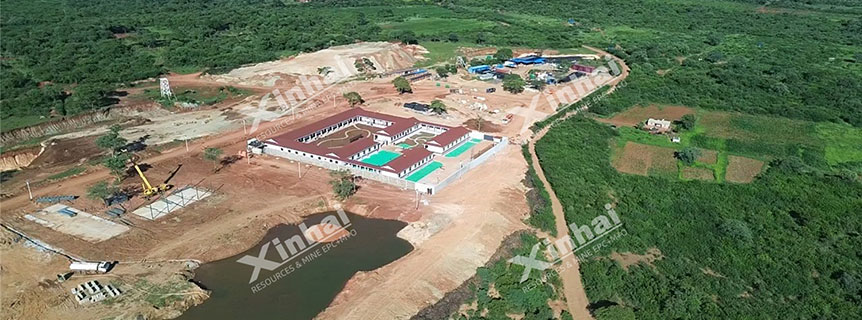
Chromium-Mine-Construction-Site
01What Is Chrome Mining?
BackChrome mining refers to the extraction of chromite ore (FeCr₄), the primary source of chromium used in stainless steel production, alloy manufacturing, and refractory materials. Chromite deposits are typically found in layered ultramafic rocks, and their geometry determines how they can be mined.
The two main mining methods are:
Open-pit mining
Underground mining
Each method is designed to suit specific geological conditions, and choosing the right one has a major impact on cost, safety, and overall project feasibility.
02Open-Pit Chrome Mining: How It Works
BackOpen-pit mining is used when chromite deposits are located close to the surface.
2.1 The Basic Process
The operation begins by removing the overburden (soil and waste rock) that covers the ore body. Once exposed, the ore is extracted in horizontal layers, or benches.
2.2 Typical steps include:
Overburden removal: This step is essential because it exposes the chromite ore body and determines the overall efficiency of the mining operation.
Drilling and blasting: Once the ore body is exposed, drilling is carried out to create a pattern of holes in the rock. These holes are then filled with explosives and detonated in a controlled sequence.
Excavation using loaders or excavators: After blasting, the broken ore is collected using heavy machinery such as hydraulic excavators or front-end loaders.
Haulage by trucks to the processing plant: The extracted ore is transported from the pit to the processing plant using haul trucks. Depending on the mine layout, this may involve traveling along haul roads with significant elevation changes.
2.3 Advantage of Open-Pit Mining
Open-pit mining is widely used because it allows for: Large-scale production; Easy access to ore; Use of high-capacity equipment
Since the ore is exposed, there is no need for tunnels or complex underground infrastructure. This significantly reduces both operational complexity and cost.
2.4 Limitations of Open-Pit Mining
Despite its advantages, open-pit mining has clear limitations.
It is only viable for shallow deposits
Large volumes of waste must be removed
Environmental footprint is relatively high
As the pit gets deeper, the amount of waste rock increases rapidly, making the operation less economical.
03Underground Chrome Mining: How It Works
BackUnderground mining is used when chromite deposits are located deep below the surface or when surface mining becomes uneconomical.
3.1 The Basic Process
Instead of removing surface layers, underground mining involves accessing the ore body through shafts or tunnels.
Common steps include:
Shaft or decline development: This stage involves drilling, blasting, and ground support installation to ensure stability and safety.
Drilling and blasting within ore zones: Proper blast control is essential underground, as poor fragmentation or instability can directly impact safety and production continuity.
Ore extraction using underground equipment: Efficient extraction at this stage is crucial to minimize ore loss and dilution, both of which directly affect the profitability of the operation.
Transport via conveyors or trucks to the surface: The choice depends on mine depth, production scale, and layout.
3.2 Advantage of Underground Mining
When ore bodies are deep or narrow, open-pit mining becomes impractical.
Underground mining allows operators to: Target specific ore zones; Reduce surface disturbance; Maintain economic extraction at depth
In many chromite deposits, especially layered reefs, underground mining is the only viable option.
3.3 Challenges of Underground Mining
Underground operations are more complex and costly due to: Ventilation requirements; Ground support systems; Limited working space; Higher safety risks.
In addition, production rates are usually lower compared to open-pit operations.
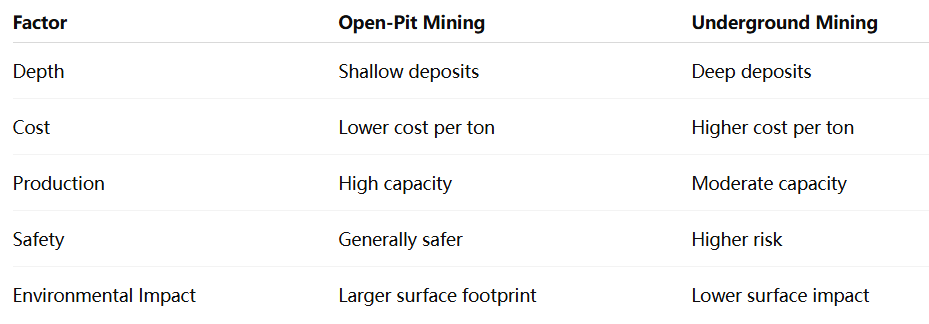
04Key Differences Between Open-Pit and Underground Chrome Mining
BackUnderstanding the differences helps determine which method is more suitable.
05Conclusion
BackOpen-pit and underground mining are two fundamentally different approaches to extracting chromite ore, each suited to specific geological and economic conditions.
Open-pit mining offers lower costs and higher production for shallow deposits
Underground mining enables access to deeper or more complex ore bodies
The optimal choice depends on the characteristics of the deposit, not on preference. Understanding these differences is essential for designing an efficient and economically viable chrome mining operation.


RELATED PRODUCTS
-
Peripheral Transmission Thickener
-
Spring Cone Crusher
-
Hydraulic Motor Driving Center Thickener